

12 ManagementRealities
The time to reinvent is now.
Our book maps twelve realities that are already changing how organisations lead, decide and grow: from DIY software and AI agents to the 4-hour workday and the virtual customer. Written by Karl Krainer and David Fauck with the Gedankenfabrik team.
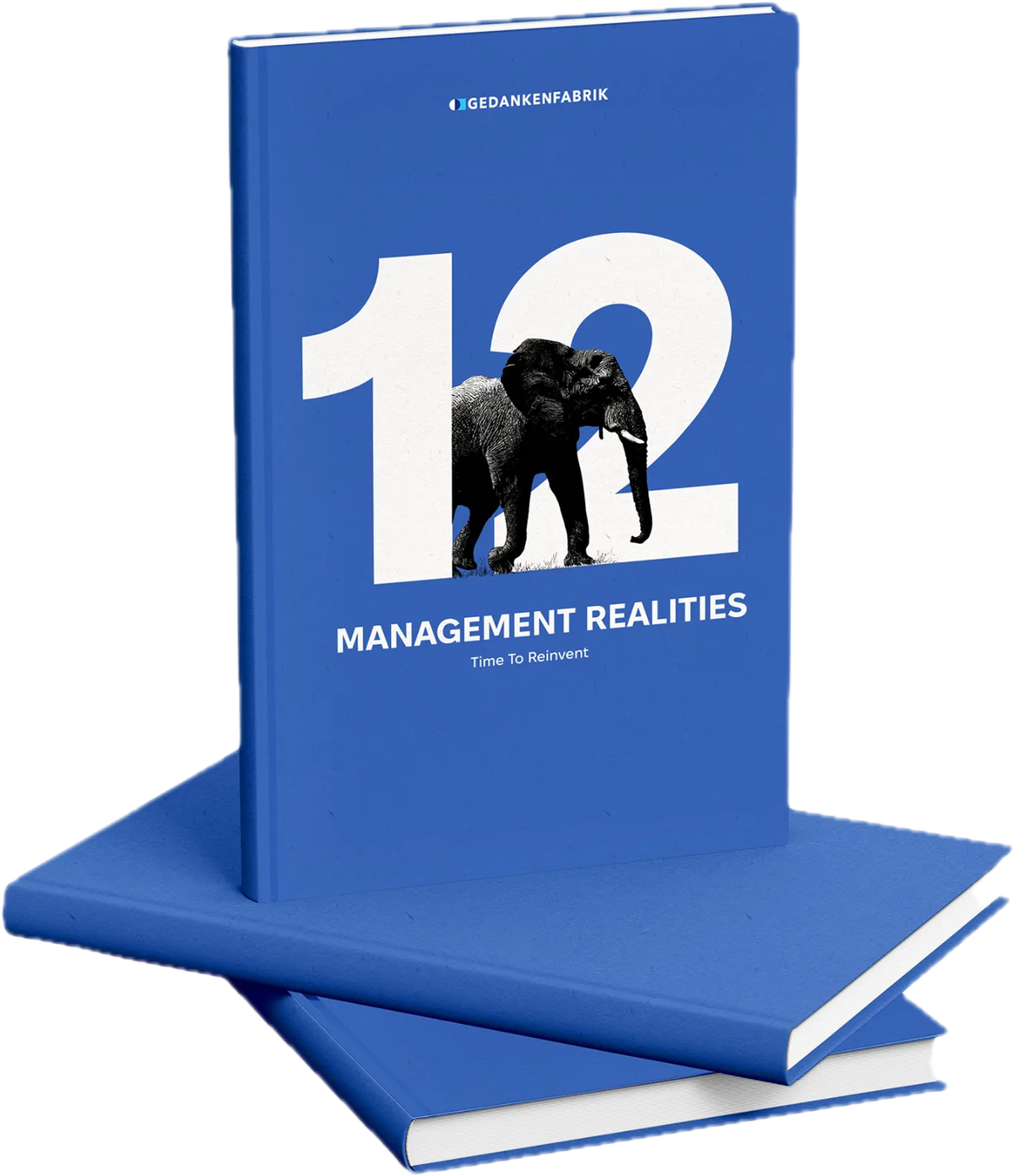
The elephantin the room.
Each reality is an elephant: already there, hard to deny and impossible to ignore once you have seen it. Yet many organisations are very good at arranging the furniture around it.
The elephants don’t stand still. They move together, overlap and push each other like a herd. Every leadership team will meet them. The real question is how consciously.
“The greatest danger in times of turbulence is not the turbulence; it is to act with yesterday’s logic.”
12 Management Realities · The exhibition
Welcome to the Roaring Intelligent 20s
Twelve realities,three clusters.
Why art?
Every ism in art marks a time when economics, society and technology changed, and people began to see the world differently. That is why each reality in the book has its own art epoch. Walk through the exhibition, look closely and take your time.
Cluster 01 · The forces of change
Why reinvention is no longer optional
Before organisations reinvent how they work, it helps to see what is driving the change: technological acceleration, shifting power and a world pulling in several directions at once.
DIY Rocks and Rolls
Why Street Art?
Street art needs no gallery and no permission. Like a stencil on a concrete wall, DIY tools take creation out of the specialists’ hands and put it where the work happens.
Inside the chapter
In a Nutshell
- Prediction
- By 2030, a large share of business technology will be built without traditional coding as the bottleneck. IT and standard software stay, but the centre of gravity moves to the people who do the work.
- Rationale
- Software now feels like the apps people already use, and natural language lowers the barrier to building. Teams can fix local friction themselves, with faster feedback and a better fit.
- Tools
- Lovable turns a written description into a working app, and assistants such as Claude turn an idea into a clickable prototype in minutes. Automation platforms connect the systems you already use.
- Actions
- Get hands-on as a manager and create examples others can copy. Your people will try these tools anyway, so provide enablement, light governance and clear rules for data and ownership.
Reinvention Story · IKEA
IKEA has reinvented doing it yourself for seven decades: flatpack furniture in the 1950s, AR room planning in 2017, 3D design tools in 2022. The customer stayed the designer while the toolkit kept moving. Next, IKEA wants to become the world’s largest smart home brand.
Interview
AI & Strategy Consultant
Companies should treat learning agility as a capability and move from rigid control to light governance. “People stop being consumers of software and start being makers of it, and that changes how they feel about their work.”
See also: 02 Everything + AI · 05 Workflow Engineer
Everything + AI
Why Readymade?
Duchamp turned everyday objects into art by putting them in a new context. +AI does the same with everything a company already owns and does.
Inside the chapter
In a Nutshell
- Prediction
- By 2030, AI strategy stops being a separate topic, just as internet strategy did. AI is judged like any other part of the operation: by what it produces, what it costs and what happens when it fails.
- Rationale
- Converging technologies have made +AI the baseline for innovation. Connecting systems and data keeps getting easier, so waiting has become riskier than starting early.
- Tools
- Track how AI turns agentic and how people actually use it. Then pick one ecosystem, such as OpenAI, Google, Anthropic or Mistral, and build your own toolbox around it.
- Actions
- Set your North Star first, with the customer in view, and redesign three regular workflows instead of adding chatbots on top. Align on AI strategy before you scale.
Reinvention Story · Google
In 2017 Google researchers published the Transformer. Five years later ChatGPT, built on it, threatened Google’s own search business. After its Code Red in December 2022, Google rebuilt search around generated answers with Gemini, AI Overviews and AI Mode.
See also: 01 DIY Rocks and Rolls · 04 Global Perspectives on AI
Educated Decision-Maker
Why Minimalism?
Minimalism strips everything back to what matters. The Educated Decision-Maker does the same: cutting through the noise to what really drives a decision.
Inside the chapter
In a Nutshell
- Prediction
- Educated Decision-Makers, active and tech-savvy customers, decide which products succeed and which platforms disappear. Their influence, measured in Knowledge Currency Units, grows with every new AI tool.
- Rationale
- The information gap between companies and customers has closed, and EDMs often know more than the brands they deal with. Companies have to treat them as partners, not targets.
- Tools
- The EDM framework links the customer’s learning curve to emerging technology, alongside the Technology Acceptance Model and the Customer Empowerment Framework. It builds on our 2016 book “The EDM: The Genesis of the Educated Decision-Maker”.
- Actions
- Treat EDMs as full members of the team. Understand their digital maturity and offer explainable AI, customisation and easy feedback.
Reinvention Story · Netflix
DVD-by-mail in 1997, streaming in 2007, original content in 2013, an ad-supported tier in 2022. Each step undercut the one before. Netflix builds every version of itself to be replaced by the next.
Interview

Professor of Market, Consumer and Media Psychology
EDMs shape their own decision environments, and AI multiplies that power. “They want explanations, not slogans. Collaboration, not persuasion.”
See also: 11 Virtual Customer · 09 Agents Everywhere
Global Perspectives on AI
Why Shanshui?
A Shanshui landscape never shows itself from a single angle; you walk through it. AI is the same: it looks different depending on where you stand.
Inside the chapter
In a Nutshell
- Prediction
- AI will not converge into one global model. It develops in regional ecosystems shaped by culture, platforms and infrastructure, and China shows what happens when AI becomes infrastructure.
- Rationale
- AI is a layered landscape of values, regulation and infrastructure that looks different from every vantage point. Watch how people actually adopt it and you see the next development earlier.
- Tools
- First-hand exposure. In China, use a local smartphone and local apps, from search and shopping to payments, and let local colleagues walk you through their routines.
- Actions
- Travel to China, South Korea or other markets. If you can’t, test apps such as Kimi in their international versions, ten minutes at a time, as a habit.
Reinvention Story · Xiaomi
The phone maker announced it would build cars in March 2021 and shipped the first one in March 2024. The SU7 took 89,000 orders in 24 hours and outsold the Tesla Model 3 in China by the end of 2025. The cars run HyperOS, the same system as the phones.
Interview
Data Driven Business Innovation · China expert & speaker
Study loop closure: connecting attention, action and outcome in one seamless flow. “Measure the strategic value of AI by what becomes possible, not by what gets cheaper.”
See also: 02 Everything + AI · 03 Educated Decision-Maker
Cluster 02 · The new ways of operating
How organizations must relearn to operate
Once the forces are understood, the interesting question follows: how do organisations actually adapt the way work is designed, decisions are made and leadership is practised?
Workflow Engineer
Why Bauhaus?
At the Bauhaus, clarity and function defined form. The Workflow Engineer works in that spirit: designing work so that it simply works.
Inside the chapter
In a Nutshell
- Prediction
- Within two years, Workflow Engineers will be as common as Product Owners. Increasingly, they lead the agents that generate, adapt and optimise workflows.
- Rationale
- AI turns employees into orchestrators. Someone has to design the process blueprint, assemble the bots and lead the change: a rare mix of skills that makes the Workflow Engineer the bridge between strategy and execution.
- Tools
- n8n, Make, Zapier, Power Automate, Celonis, ServiceNow and UiPath. Gartner groups the category as BOAT: Business Orchestration and Automation Technologies.
- Actions
- Define the role and run a “30-day-Flow” pilot on one inefficient process. Then scale it so every business unit connects to one shared system.
Reinvention Story · Zapier
In March 2023 GPT-4 moved into Zapier’s own territory. The company paused normal work for a week so every team could build with the new APIs, and regular AI use went from one in ten employees to more than half. Hiring, pricing and HR followed over the next two years.
See also: 01 DIY Rocks and Rolls · 09 Agents Everywhere
Red Tape to Green Tape
Why Classicism?
Classicism promised order through harmony and proportion, and so did bureaucracy. Today that perfect symmetry is too rigid for the speed we need.
Inside the chapter
In a Nutshell
- Prediction
- AI speeds up routine approvals and replaces rigid processes with flexible workflows. Teams act faster, take ownership and decide with fewer levels in between.
- Rationale
- AI finds the bottlenecks, simplifies approvals and makes processes transparent. Management sheds administration, down to everyday travel expenses, and refocuses on creating value.
- Tools
- Notion keeps knowledge, data and work in one place, so agents know the house rules. Norm Ai turns regulations and policies into live checks that record why the answer was yes or no.
- Actions
- Find where approvals take too long, set clear rules for autonomy and let AI handle routine decisions. Test with simulations, train people and show the time saved.
Reinvention Story · LEGO
By 2004 LEGO was losing close to a million dollars a day, buried in complexity. Jørgen Vig Knudstorp started with subtraction: he sold the theme parks and cut unique pieces from over 12,000 towards 7,000. In 2014 LEGO became the world’s largest toymaker.
See also: 05 Workflow Engineer
The AI Manager Dilemma
Why Surrealism?
In a surrealist’s dream, clocks melt and certainties dissolve. Managers know the feeling: the ground keeps shifting while they lead.
Inside the chapter
In a Nutshell
- Prediction
- Managers sit in a super sandwich position: between a C-level asking for AI and speed, and teams with new structures and skills of their own.
- Rationale
- In a BANI world (brittle, anxious, nonlinear, incomprehensible) there is no blueprint for this reinvention. Managers have to rethink how business works and what they contribute.
- Frameworks
- Frameworks instead of tools: BANI to read the environment, the Reinvention Wheel to transform, Adaptive Leadership to lead without a playbook, Human + Machine and Hub-and-Spoke to spread AI capability.
- Actions
- Lead the transition yourself: keep a leadership journal, spend 20% of your time experimenting, meet a peer circle and check in with your team often.
Reinvention Story · Haier
In 1985 Zhang Ruimin had 76 defective refrigerators smashed with sledgehammers. From 2005 he took apart the hierarchy itself: with RenDanHeYi, middle management gave way to thousands of microenterprises of ten to fifteen people with their own hiring, pay and numbers.
See also: 03 Educated Decision-Maker · 08 OKRs on Steroids
OKRs on Steroids
Why Abstract Art?
On an abstract canvas, patterns shift and colours flow. OKRs are becoming just as fluid: living systems instead of fixed targets.
Inside the chapter
In a Nutshell
- Prediction
- Real-time data, predictive analytics and copilots write, align and monitor goals continuously. Static scorecards turn into dynamic dashboards.
- Rationale
- OKRs move from a quarterly ritual to a self-learning system connected to data across the organisation. Leaders shift from reporting to real-time coaching.
- Tools
- Microsoft retired Viva Goals at the end of 2025. AI-native platforms such as WorkBoardAI, Rhythms and Workpath pull metrics, draft objectives and flag drift before the quarter ends.
- Actions
- Open an OKR test lab. Break the work down task by task, decide where a person judges and where AI takes over, and scale once goal-hit rates and engagement climb.
Reinvention Story · The New York Times
A print newspaper for 165 years, it introduced a paywall in 2011 against industry consensus. With games like Wordle and an all-access bundle it became a set of products people open every day: more than 13 million subscribers by early 2026.
Interview

Senior Manager AI & Transformation
Goals stop being reported on and start being shaped. “The biggest shift is that OKRs stop being a quarterly ritual and become a living system.”
See also: 07 The AI Manager Dilemma · 10 4-Hour Workday
Cluster 03 · The unlocked future
What becomes possible after reinvention
Agents, shorter workdays, virtual customers and new workplaces have stopped being futuristic ideas. They show what becomes achievable when reinvention turns into a discipline.
Agents Everywhere
Why Pop Art?
Pop Art is bold, loud and everywhere. So are AI agents: they will show up in every variety and be impossible to ignore.
Inside the chapter
In a Nutshell
- Prediction
- AI agents are moving into the workflows of your organisation, and agent swarms already handle multi-step tasks well. We will reach them by talking instead of typing.
- Rationale
- Agents now remember past interactions and work together across complex workflows. With a strong case for efficiency and always-on service, they become a practical asset.
- Tools
- Four layers: work agents, enterprise platforms, task agents and frameworks, connected via MCP or A2A. Skills on top teach an agent how a job is done in your company, no developer needed.
- Actions
- Start with the work, not with the agent. Pick one challenge, give the agent a role and boundaries like a new team member, and set goals you can measure.
Reinvention Story · Nvidia
Nvidia built its first fortune on graphics chips for games and bet on CUDA in 2006 to turn them into general-purpose computers. When generative AI arrived, its data-centre chips became the foundation of the field. In 2026 it brought agent computing to the desk with RTX Spark.
See also: 03 Educated Decision-Maker · 12 Smart Office Factory
4-Hour Workday
Why Impressionism?
The Impressionists captured fleeting light in short, vivid strokes. Productivity is moving the same way: intense bursts of human focus instead of long hours.
Inside the chapter
In a Nutshell
- Prediction
- By 2030, execution runs largely machine-driven around the clock. Attention, not time, becomes the measure of productivity, with four hours of deep work as guidance.
- Rationale
- AI often intensifies work instead of reducing it, while the brain stays bound by limits of focus and energy. So the day is designed around the moments of highest human contribution.
- Tools
- Reclaim.ai, Motion and Sunsama protect prime time, Whoop and Oura make recovery measurable, Coursera, LinkedIn Learning and Maven structure learning. None of them help unless the day around them changes.
- Actions
- Split the day into work, recovery and learning slots and test it with one department. Measure output quality, learning progress and well-being, not hours.
Reinvention Story · Exos
Exos sells human performance, yet its own people were worn out after the pandemic. In 2023 it introduced You Do You Fridays, first for a third of the staff, by November for everyone. Turnover fell from 47 to 29 percent within the year.
See also: 08 OKRs on Steroids · 09 Agents Everywhere
Virtual Customer
Why Digital Art?
In digital art, pixels form a living canvas. Virtual customers are built the same way: data that turns into a co-creator.
Inside the chapter
In a Nutshell
- Prediction
- By 2030, companies move from occasional focus groups to permanent digital twins of their customers. They sit at the table as members, not as an empty chair.
- Rationale
- Success depends on using technology in ways competitors have not tried. Virtual customers help to model, predict and simulate customer behaviour.
- Tools
- concept m’s AI Personas, built on depth psychology rather than click data, neuroflash with twins trained on over a million audience profiles, and Aaru for behaviour simulation at scale. Start with a provider and connect your own data later.
- Actions
- Discuss digital twins with your research team and test one very specific use case. Expand from there, later towards agentic workflows.
Reinvention Story · Thalia
In 2013 Thalia launched tolino with fellow booksellers, Europe’s own open answer to the Kindle. It listened to its customers, invested online and opened new stores. Today young readers who talk about books online drive much of its growth.
Interview
Co-founder, concept m
AI Personas replicate the psychological deep structures of consumers and complement deep interviews rather than replace them. “They allow us to scale empathy and foresight.”
See also: 03 Educated Decision-Maker · 09 Agents Everywhere
Smart Office Factory
Why Futurism?
The Futurists dreamed of harmony between man and machine. The Smart Office Factory makes it real: people steer, systems run in rhythm.
Inside the chapter
In a Nutshell
- Prediction
- White-collar work learns from the factory. Digital twins and continuous improvement move from the shop floor into the office, with people, tools and agentic systems acting together.
- Rationale
- Industry connected step by step: first the equipment, then the people, then one synchronised system. The Smart Office Factory brings that sequence into the office to make work transparent, manageable and adaptive.
- Tools
- There is no playbook. What matters is the connective layer that turns isolated automations, data and workflows into one operating system, plus a story people understand. Siemens and Altair show connected digital twins.
- Actions
- Describe your 2030 vision boldly, then your current structure. Think about a digital twin of your office floor, and add people to the equation.
Reinvention Story · John Deere
Selling farm equipment since 1837, Deere bought Blue River Technology in 2017 and Bear Flag Robotics, and showed a fully autonomous tractor at CES 2022. More than 500 million acres now run through its Operations Center: Deere sells the farm as a connected system.
Interview

Chief Thinker & Founder, Gedankenfabrik
Organisations become flatter and move from output-driven to outcome-driven. “Think like a game developer.”
See also: 09 Agents Everywhere · 11 Virtual Customer
The bigger picture · p. 206
One tension runs through all twelve.
Individuals are moving faster than organisations. People already use AI to think, decide, create and automate, while organisations are held back by structures, governance and legacy thinking. Reinvention closes that gap.
Reinventism
Why Reinventism?
Every movement in this book gave its era a name. Ours needs one too: “Reinventism: the conviction that an organization is never finished, and that beginning again is a discipline, not a failure.” So this canvas stays unfinished.
The Reinvention Wheel: rethink the customer, rebuild your brand, reimagine creativity, reshape innovation, relearn forever.
You begin, and then you begin again.
Want to meet the herd in person? All twelve have moved into our office.
Meet all twelve in our loft Back to the entranceEvery chapter,the same path.
So you can read the book from cover to cover or jump in wherever you need to.
In a Nutshell
Predictions, rationale, tools and actions at a glance.
The Idea & Framework
What is changing, why it matters and what it means for leadership.
Think Nugget
A short prompt to connect the idea with your own organisation.
Opportunities & Watch-outs
Where the reality creates value and where it hides blind spots.
Tools & Actions
Methods, tools and concrete next steps.
Best Practices & Voices
Organisations and leaders already working with this reality.
Reinvention Story
New in this edition: a company that remade itself instead of waiting to be remade.
Interestedin workingtogether?
Karl answers personally. Pick a topic to get started.
Karl KrainerChief Thinker · usually replies within a dayWe use your details only to answer your request. Privacy policy